Latest Articles & Blog
Valuable tips and resources to grow your Amazon business




I wanted to write this because people ask me all the time why I’m so obsessed with selling on Amazon, and more specifically, flipping from eBay to Amazon.
The answer is simple. This is the business model I’ve been doing for about five and a half to six years. I’ve done over $3.5 million in sales, made well over half a million dollars in net profit, and last year alone I did over $130,000 in net profit. So when I talk about why I love this model, I’m not speaking in theory. I’m speaking from years of real experience.
There are a lot of ways to make money online, and there are a lot of Amazon business models. But this is the one I keep coming back to because it fits the way I like to work. It gives me flexibility, it removes a lot of friction, and it solves problems that come with other sourcing methods.
In this post, I want to break down the 12 biggest reasons I keep coming back to eBay to Amazon and why I’m still so bullish on it.
.avif)
One of the biggest reasons I love this model is that I can do it from home.
For years, if I wanted to find books, DVDs, electronics, tools, board games, or video games, I had to go out and get them. That meant driving to thrift stores, garage sales, library sales, or meeting people on Facebook Marketplace. There was always a lot of running around involved.
With eBay to Amazon, I can sit at home and source inventory.
That does not mean I think you should never leave the house. Balance still matters. But from a business standpoint, being able to source from home is a major advantage. It saves time, saves energy, and removes a lot of the chaos that comes with constantly driving around hoping to find enough good inventory.
Instead of chasing the business, the business comes to me.

Another reason I love this model is that I can source whenever I want.
When you source locally, you are tied to store hours, sale times, and travel time. If you want to go to Goodwill at midnight, you are out of luck. If you want to hit a garage sale, you have to wait until it actually happens. Local sourcing always depends on somebody else’s schedule.
eBay is different. It is open 24/7.
That matters more than a lot of people realize. It means I can source early in the morning, late at night, in the middle of the day, or whenever I have free time. I can work around my life instead of forcing my life around sourcing.
That flexibility is a huge part of why this model fits me so well.
I come from a thrifting background, and that still shapes how I look at this business.
I spent years in thrift stores. I used to buy clothing, travel all over the country, and spend a ton of time sourcing in person. What I always liked was the feeling of finding overlooked products and spotting value where other people missed it.
That is why eBay connects with me so much.
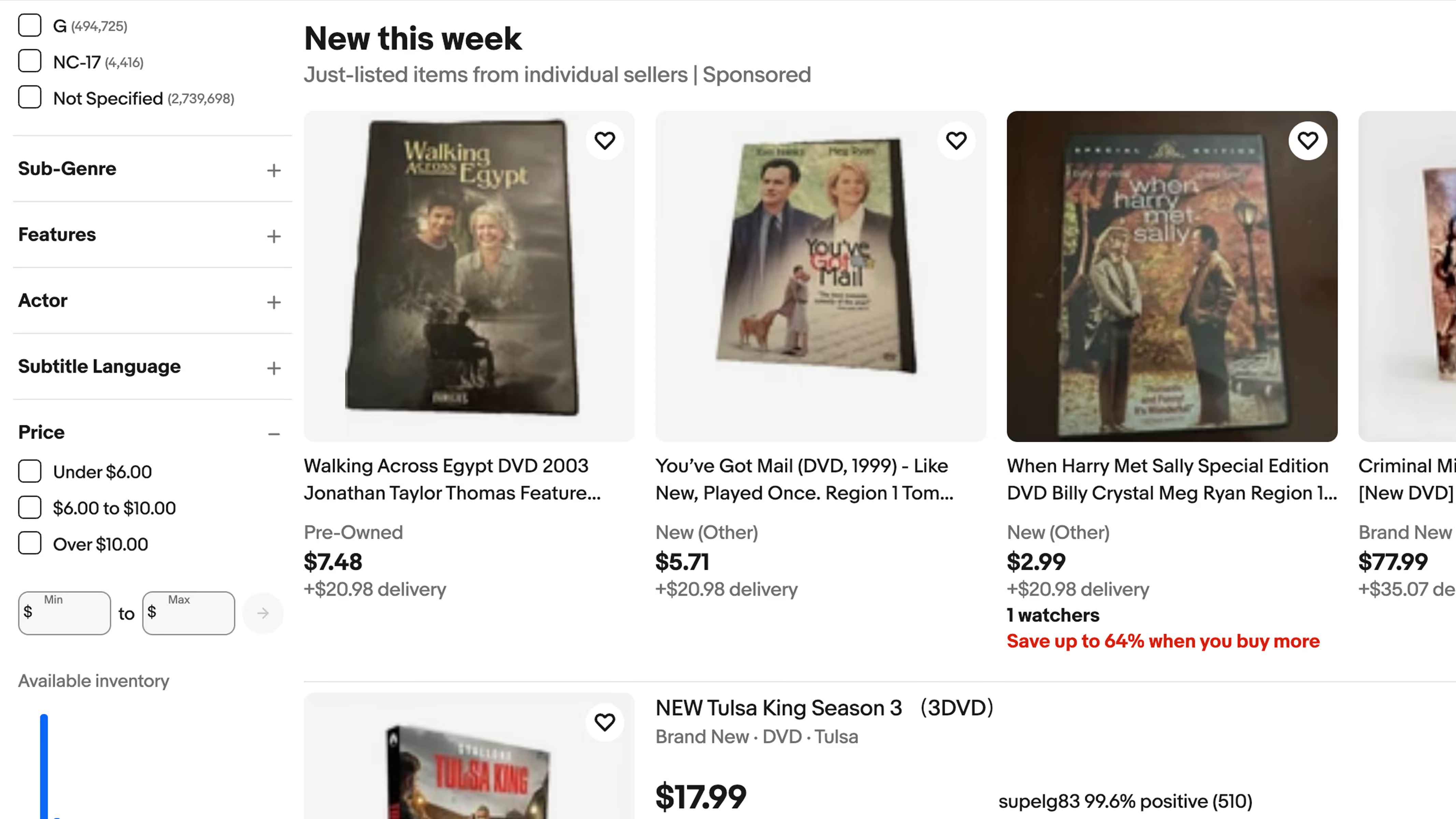
To me, eBay feels like a 24/7 digital thrift store. A lot of the items I buy are books, DVDs, board games, and video games from everyday people. Some sellers are just clearing out stuff from around the house. Some are resellers. Either way, it still has that same treasure-hunt feel that made me love reselling in the first place.
It does not feel boring to me. It feels like there is opportunity everywhere if you know how to look.
I also like eBay to Amazon a lot more than models like private label or wholesale.
What I like here is accessibility. You do not need to spend huge money importing products, trying to rank listings, running ads, or building a big private label operation. You also do not need to chase large wholesale numbers that may not look as attractive once you factor in overhead, debt, and everything else.
What I love about eBay to Amazon is that regular people can actually do it.
You can start small. You can buy inexpensive items. You do not need to be a giant company to make it work. To me, that makes it a real and practical business model for people who want something they can actually build.
This model also makes sense for people who cannot run all over the place sourcing inventory.
Not everybody has time to spend all day at thrift stores. Not everybody can drive around constantly. Not everybody wants to drag kids all over town trying to find enough products.
That is one reason this model is so appealing. If you need to be home more, if you are taking care of kids, or if you simply do not want to spend your days on the road, eBay sourcing gives you an option that is much more flexible.
That makes the business more realistic for more people.
A lot of people assume eBay is too competitive or that everything is already priced efficiently.
That is not how I see it.
I am buying from everyday people, and even when I am buying from experienced sellers, there is still plenty of opportunity. It reminds me of thrift stores in that way. Even if some people know what they are doing, so many products move through the system that things still fall through the cracks.
There are still underpriced items. There are still overlooked items. There are still differences between what something is worth on eBay and what it is worth on Amazon.
That gap is the opportunity.
.avif)
This is one of the biggest reasons the model works in the first place.
An item can be priced completely normally for eBay and still be worth much more on Amazon. That difference is where the profit comes from.
For example, a DVD might sell for $30 all day on eBay but bring $60 on Amazon. That does not always mean the eBay seller made some huge mistake. It can simply mean the item has a different market value on each platform.
The two marketplaces are different. They have different buyers, different buying behavior, and different price expectations.
Understanding that price gap is one of the biggest keys to understanding why this business works.
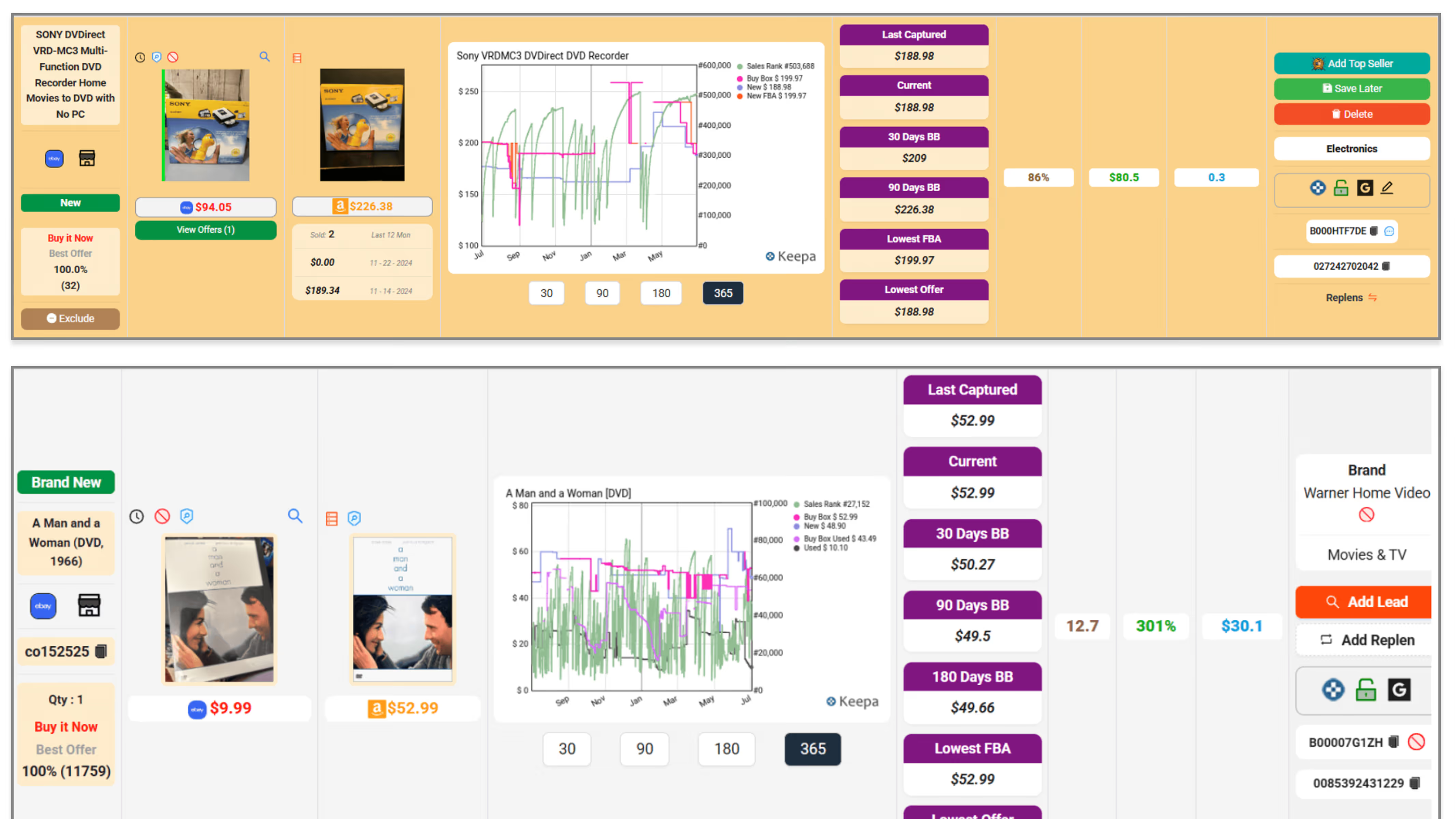
Another reason I’m so bullish on this model is that software can do a lot of the heavy lifting.
When you source at thrift stores or library sales, there is a lot of manual work involved. You have to pick up every item, scan it, and analyze it one by one. There is skill involved, but there is also a lot of labor involved.
With eBay to Amazon, software like Replen Catcher can make the process much more efficient.
Replen Catcher tracks millions of products. You can set filters based on ROI, profit, category, and other criteria, and it can bring you opportunities that match what you are looking for. If you want used DVDs above a certain price with a certain ROI and profit target, you can filter for that and get a large number of results.
That is a major advantage. Every day there are thousands of new opportunities, and the software helps bring better deals to the surface.

The profit margins in this model can get really strong, and one reason is that eBay gives you room to negotiate.
If somebody has an item listed for $30 and I can make a best offer for $20 or $25, that can change the entire deal. A small change in buy cost can make a big difference in ROI and final profit.
That is one of the best things about eBay. You can negotiate. You can message sellers. You can improve the deal. You can create margin.
That is much harder to do in most in-person sourcing situations.
This business is not only about one-off flips.
Over time, when you buy consistently on eBay, you can build relationships with sellers and sometimes turn that into larger opportunities. I mentioned an example of someone in my group working on a very large Lego deal with an eBay seller.
That is important because it shows the model can grow beyond random single purchases. As relationships get stronger, repeat opportunities can show up, and that creates more leverage over time.
One of the things I love most now is that this model can grow beyond just my own effort.
I have a full-time staff and virtual assistants in the Philippines who use Replen Catcher, source items for me, and purchase on my behalf. That took time to train, and it was not easy, but it changed the business for me.
Once you get to that point, you are not doing every single task yourself anymore. You can build leverage. You can build systems. You can build a team.
That is where the business starts to get really exciting.

The last big reason I love this model is the prep center setup.
For the first few years, I had everything shipped to my house. Now, when my virtual assistants buy items, they get shipped to my prep center, Little Owl Prep in Ohio. They inspect the products, prep them, ship them to Amazon FBA, and then Amazon handles fulfillment when the products sell.
At that point, I am not touching the inventory. I am not sourcing every item myself. I am not listing every item myself. I am not pricing every item myself.
It took time, capital, and hard work to get there, but the fact that this business can eventually run that way is one of the biggest reasons I’m so obsessed with it.
At the end of the day, I’m obsessed with eBay to Amazon because it solves so many problems at once.
I can do it from home. I can source whenever I want. It still feels like treasure hunting. The margins can be excellent. Software can take on a lot of the work. A team can help scale it. A prep center can remove even more of the hands-on effort. And you can start small and build into something much bigger over time.
Last year I did around $750,000 in sales and about $130,000 in net profit. This year my goal is over $1 million in sales and somewhere around $160,000 to $200,000 in net profit after paying team, virtual assistants, refunds, and everything else.
So when I say I love this business, I do not mean it casually. I’m obsessed with it because I believe in it, I’ve built around it, and I still think there is a lot of opportunity here for people who want to learn it and take it seriously.
Be the first to know about new features, product updates, and improvements — no spam.
Valuable tips and resources to grow your Amazon business
Join thousands of sellers using Replen Catcher to source profitable inventory faster.