Latest Articles & Blog
Valuable tips and resources to grow your Amazon business




I wanted to write this because a lot of people are interested in eBay to Amazon, but many of them come into it with the wrong expectations.
A lot of resellers start with thrift stores, garage sales, flea markets, library sales, pawn shops, consignment stores, and local pickups. That works well for a lot of people at first, but over time it can get harder to find enough good inventory. There are fewer donations in some areas, more competition, and the best stuff often gets picked up fast.
That is a big reason this topic matters. I recently got my mom started with eBay to Amazon on a small scale, spending about $1,000 per month. She started because it was getting harder for her to find enough inventory at thrift stores, and I know that is something a lot of people can relate to.
So in this post, I want to walk through the main things I told her when she got started. If you are thinking about trying eBay to Amazon, these are the ideas that matter most.
.avif)
The first thing I told my mom is that eBay to Amazon is all about getting your money to work for you.
That is the biggest mindset shift. When you are thrifting, a lot of the game is hustle. It is about how many stores you can hit, whether you get lucky, whether you are in the right place at the right time, and whether you move fast enough to grab the good inventory before somebody else does.
eBay is different. There are always deals sitting there. Some require best offers. Some require messaging sellers. Some go fast. But it is not the same as fighting over a limited amount of local inventory.
If you want to do well with eBay to Amazon, you cannot expect thrift store buy costs or thrift store ROI. You are not really in the hustle-and-bustle business anymore. You are in the capital business, and you are using money and software in a smarter way.
This is one of the first realities people need to accept.
At a thrift store, you might buy something for $1 and sell it for $20. On eBay, that usually is not what the math looks like. You might spend $10 on a DVD and sell it for $30. You might spend $29 on a board game and sell it for $62.
The ROI is often going to be more modest. A lot of the time it may be 40%, 50%, or 60%. That does not make it a bad model. It just makes it a different one.
In the beginning, one of the biggest mistakes is comparing every eBay deal to the best thrift score you ever found. That is the wrong comparison. Over time, the real power comes from building a replens list and finding items you can source again and again.
.avif)
I usually recommend setting aside at least $500 to $1,000 to get started. More is even better, but that does not mean you should spend it all right away.
The point is that this model takes more capital than a lot of people expect, and your money stays tied up longer. You buy the item on eBay, then you wait for it to arrive. If you send it to Amazon FBA, you may wait another couple of weeks for it to get checked in. After that, it still has to sell.
That delay matters. Even when you are making good buys, the cash does not come back right away. If you do not plan for that, you can put yourself in a bad position even if the deals themselves are good.
.avif)
The next thing I told my mom is that she needed good software.
The software we use is Replen Catcher. The easiest way to think about it is this: when you are in a thrift store, you use a scanning app to find potential deals. With eBay to Amazon, Replen Catcher is doing that work on eBay. Instead of physically scanning books, DVDs, or games yourself, the software brings potential deals to you.
That is a huge part of making this model work, but software does not mean you can stop thinking. You still have to check whether you are gated or restricted. You still have to read the Keepa chart. You still have to make sure it is the right product, because mismatches happen. You still have to confirm the deal is actually profitable, because the buy box changes all the time.
Software is important. It just does not remove the need for judgment.
.avif)
If you are new, this matters a lot.
If you have mostly been selling books, there is a good chance you are going to be gated in many other categories. Instead of getting frustrated about what you cannot sell, focus on what is already open to you.
That is what I told my mom. If you can sell books, start with books. If you can sell DVDs, start with DVDs. There are still plenty of opportunities in those categories.
You do not need to sell everything. You just need enough profitable items inside the categories and brands you are already allowed to sell.
A lot of people see a restricted item and instantly move on. Sometimes that makes sense, but not always.
Some items are not hard gated. Sometimes you just need to apply, and you may get approved. That is one reason I like having software connected to an Amazon account. It makes it easier to see what you are restricted on and what you may be able to get approved for.
I had my mom do this, and she ended up getting ungated in a lot of items, including DVDs, toys, and games. At the same time, if you are brand new, you are not going to be able to sell everything that a more experienced seller can sell. That is normal.
Over time, the more you sell, the more Amazon tends to trust you, and that can lead to more auto ungates.
.avif)
This is something I would be careful with at the beginning.
A lot of people get excited and think they need to spend money getting ungated in a bunch of brands and categories right away. I would not do that. There are already enough opportunities in books and DVDs to learn the model and begin building experience.
Early on, the goal is not to unlock everything. The goal is to learn the process, build confidence, and make solid buys inside the categories that are already open to you.
This is one of the most important tips I can give.
Even if you have the money, start slow. When I first started eBay to Amazon, I only spent $50 the first week. Then I made some mistakes, made some good flips, learned from it, and slowly increased from there. Then it became $100 a week, then $200, then $500, then $1,000.
That is the right way to do it. You are going to make mistakes. You are going to misread listings. You are going to buy things you should not have bought. The key is to keep the stakes small while you are learning.
That is exactly how my mom approached it too.

If you want to do eBay to Amazon well, you need to learn how to read Keepa.
You need to understand price history. You need to look at the relationship between seller count and price. You need to pay attention to seasonality, buy box history, whether Amazon is on the listing, who is winning the buy box, and how many sellers are on the listing.
There is a lot going on inside a listing, and beginners often get in trouble because they only see the surface-level profit. They do not really understand what the chart is telling them.
That usually leads to worse buying decisions.
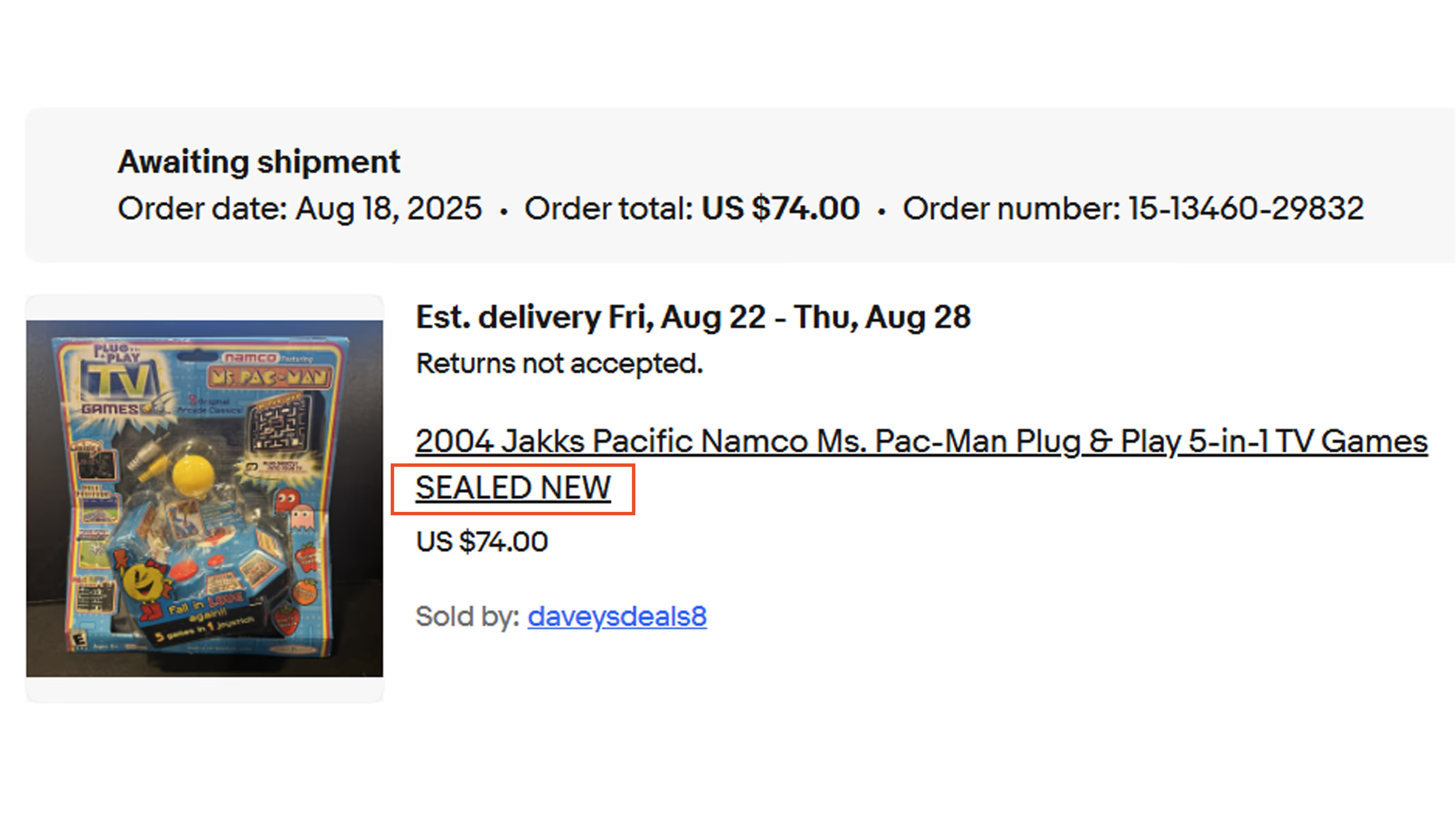
When you buy on eBay, you are buying from random people. That means you need to slow down and actually inspect the details.
Look at the pictures. Read the title. Read the description. Check the seller feedback. Make sure the seller looks legitimate. Make sure the item actually matches the Amazon listing.
And if you are unsure, message the seller.
A lot of preventable mistakes happen because people move too fast. Paying attention here is a big part of making the model work.
This is something many people leave on the table.
Do not just see a deal at 30% ROI and buy it immediately. If the seller accepts best offers, make one. Send messages. Negotiate. Work the deal.
A lot of deals become much better just by asking. That matters because your capital is valuable. There are always more deals on eBay, so you do not want to spend your money just because something technically makes a profit. You want the deal to be strong enough to deserve your money.
This is another beginner trap.
Something can make money on paper and still not be a good buy. You have to look at more than just profit. Pay attention to ROI, how often the item is selling, and whether the margin is strong enough to justify tying up your money.
It is not enough for an item to be profitable. It should also move well and make enough margin to be worth the risk and the wait.
That is a much better way to think about your buys.

Later on, you can outsource more. You can hire virtual assistants, use a prep center, and build systems around the business.
But in the beginning, I would stay close to it. Have the items shipped to your house. Inspect them yourself. Analyze the products yourself. Make sure the condition is right yourself.
That is how you learn. That is how you catch mistakes. That is how you build better judgment. If you outsource too early, it becomes easier to make bigger mistakes at a larger scale.
You are going to make mistakes in the beginning. That is part of it.
The goal is not to avoid every mistake. The goal is to start small enough that your mistakes do not crush you, and to actually learn from them. Once you get better at reading Keepa, better at analyzing deals, and better at building your own list of things that work, the model starts to make more sense.
You are not starting from scratch forever.
At the end of the day, my mom has really been enjoying eBay to Amazon, and I have too for a long time. One of the biggest reasons is simple: we do not have to drive all over the place looking for inventory. The products come to us.
Yes, it takes more capital. Yes, there is a learning curve. Yes, you need discipline. But it is also more scalable, and it can become a very efficient way to source inventory once you understand how it works.
If you want to get started, keep it simple. Start slow. Use good software. Focus on what you can sell. Learn how to read Keepa. Pay attention to condition. Negotiate. And stay close to the business until you know what you are doing.
That is still the best way I know to get started with eBay to Amazon.
Be the first to know about new features, product updates, and improvements — no spam.
Valuable tips and resources to grow your Amazon business
Join thousands of sellers using Replen Catcher to source profitable inventory faster.